Griddles
Choosing your first griddle
Where it will live, how much surface you need and which features change daily use. A practical way to narrow down a first outdoor griddle.
In this guide
Research only. Compiled from manufacturer and Amazon listings, owner's manuals and NFPA safety guidance, read on November 1, 2026. Evidence labels explained.
This article has paid links: Sizzlefolk may earn a commission if you buy through them. As an Amazon Associate I earn from qualifying purchases. How affiliate links work here.
Start with the space, not the brand. Measure where the griddle will actually sit, decide how much surface you’ll really use, and only then compare models. That order rules out most of the list before you’ve read a single review.
If you cook for a household on a patio with room to spare, a freestanding griddle around 28 inches is a sensible place to begin looking. If you’re short on space or want to take it camping, look at tabletop models. Only go to 36 inches if you regularly cook for a crowd.
Measure the space first
This is the step people skip, and it can settle the decision on its own. Outdoor griddles need open air around them, and the required distance is larger than many people expect:
- The Pit Boss 4-burner manual asks for 50 inches from combustible construction at the sides and back.
- The manual for a 5-burner Pro Series natural gas griddle asks for 36 inches on all sides, including from deck railings and walls.
Those are two manuals, not a rule for every griddle, so read the one for the model you’re considering. Most manufacturers post manuals online, and you can read them before you buy.
NFPA gives the same advice for grills: keep them well away from the home and deck railings, and out from under eaves and overhanging branches. Its figures for 2020 to 2024 show nearly a quarter of grill structure fires started on an exterior balcony or open porch.
Choose a size for how you actually cook
Width is the headline number, but cooking area is what you’re paying for, and not every listing gives it. Here’s what a few manufacturer listings showed on November 1, 2026. These are examples of each size, not recommendations, and prices change often.
| Size | Example | Listed details | Price |
|---|---|---|---|
| Tabletop | Pit Boss 2 Burner Tabletop with Cover | Cover included | $149.99 |
| Tabletop | Blackstone Original 17” with Hood | Hood included | $189.99 |
| Small with stand | Blackstone 22” with Stand | Stand included | $339 |
| Mid-size | Blackstone 28” Omnivore | 517 sq in, 73 lb, 2 heat zones. Listed as backordered | $279 |
| Mid-size | Pit Boss 4-Burner PB4BGS1 | 753 sq in, 4 controlled zones | $399.99 |
| Large | Blackstone 36” with Hood | 135 lb, hood included | $499 |
A few things stand out:
- Cooking area varies more than the names suggest. The Pit Boss 4-burner lists about 45% more cooking area than the Blackstone 28”.
- Price doesn’t track size neatly. That 22” with a stand is listed higher than the 28”, so compare what’s included, not just the width.
- Listings aren’t always consistent. One Pit Boss listing shows both 265 and 289 square inches on the same page. If a number matters to you, check the manual or ask the manufacturer.
The features that change daily use
Separate heat zones. Each burner usually gives you a zone you can set on its own, so you can keep one area hot for searing and another low for holding food. Two zones can do this. More zones give you more room to work with.
Grease handling. Every griddle needs somewhere for grease to go. Blackstone’s 28” uses a rear system, and Pit Boss’s 4-burner uses a grease cup. Look at where it sits and how you’d empty it. Pit Boss says to empty and clean its cup after each use, and warns against ever cooking without it, so you’ll be doing this often.
Hood or cover. A hood stays attached and can be opened and closed. A soft or hard cover comes off completely. Either protects the surface between cooks, and you’ll want some form of protection because bare steel can rust. Check which you’re getting, since many listings sell the same griddle with different tops.
Moving it around. The Blackstone 28” weighs 73 pounds and the 36” with hood weighs 135. If it has to roll out of a shed or garage, check the wheels. That 28” has two fixed casters and a side handle for moving it.
Fuel. Most griddles run on propane, and natural gas models exist if you have a line outside. Check before you order, because they’re sold as different models.
Budget for more than the griddle
Pit Boss’s manual says fuel and accessories aren’t included, so check what comes with the griddle you’re considering. Plan for:
- A propane cylinder, unless you already have one or you’re on natural gas
- A few basic tools, including a food thermometer
- A cover, if it doesn’t come with one
- Oil and paper towels for seasoning
Before your first cook
- Leak test. Pit Boss’s manual calls for a leak test before first lighting, each time the cylinder changes, after travel and after long storage. NFPA describes the same soapy water method. Bubbles mean gas is escaping, and you should never use a flame to check.
- Season the surface. Blackstone’s guide has you wash a new griddle once with soap, then build up several thin layers of oil. Pit Boss says its griddle comes preseasoned, but still needs cleaning and seasoning after each use. Follow your own manual.
- Keep the tank outside. Pit Boss says cylinders must be stored outdoors, never in a building or garage, and that a spare shouldn’t sit under or near the griddle. Leave the cylinder outside even if the griddle goes indoors for the winter.
- Outdoors only. Never use it in a garage, tent, camper or other enclosed space. Pit Boss’s manual warns about carbon monoxide.
So which one?
There’s no single winner, because the right griddle depends on your space and how you cook. Here’s a way to narrow your own list:
- Rule out anything that won’t fit your space with the manual’s clearances.
- Choose tabletop, mid-size or large based on how many people you usually feed and whether it needs to travel.
- Compare cooking area, grease handling and what’s included, not just the width.
- Read the manual and the warranty for your final two.
Where to start looking
Here’s one griddle at each size to start your comparison. These are different models from the examples in the table above, so check the listing and the manual before you buy.
Still not sure you want a griddle at all? Start with griddle or grill. Buying for someone else? Our griddle gift ideas include smaller ways to start.
This article has paid links: Sizzlefolk may earn a commission if you buy through them. As an Amazon Associate I earn from qualifying purchases. How affiliate links work here.
Sources
- Owners Manual for Pit Boss 4-Burner Griddle, models PB4BGS1 and PB4BGD1
- Pro Series 5 Burner Natural Gas Griddle, Assembly Instructions & User Manual, model G70303
- Grilling Safety Facts & Resources
- 28" Omnivore Griddle
- Original 17" Tabletop Griddle with Hood
- 22" Griddle with Stand
- 36" Griddle with Hood
- 4-Burner Griddle, PB4BGS1
- Gas Griddles
- 2B Griddle with Cover & Adapter, PB336GS
- How to take care of your griddle, complete guide
Related guides
Griddles
Griddle or grill: where should you start?
A griddle cooks on a flat steel plate and a grill cooks over grates. Here's how that changes your meals, cleanup and first purchase.
Read the comparison: Griddle or grill: where should you start?
Tools
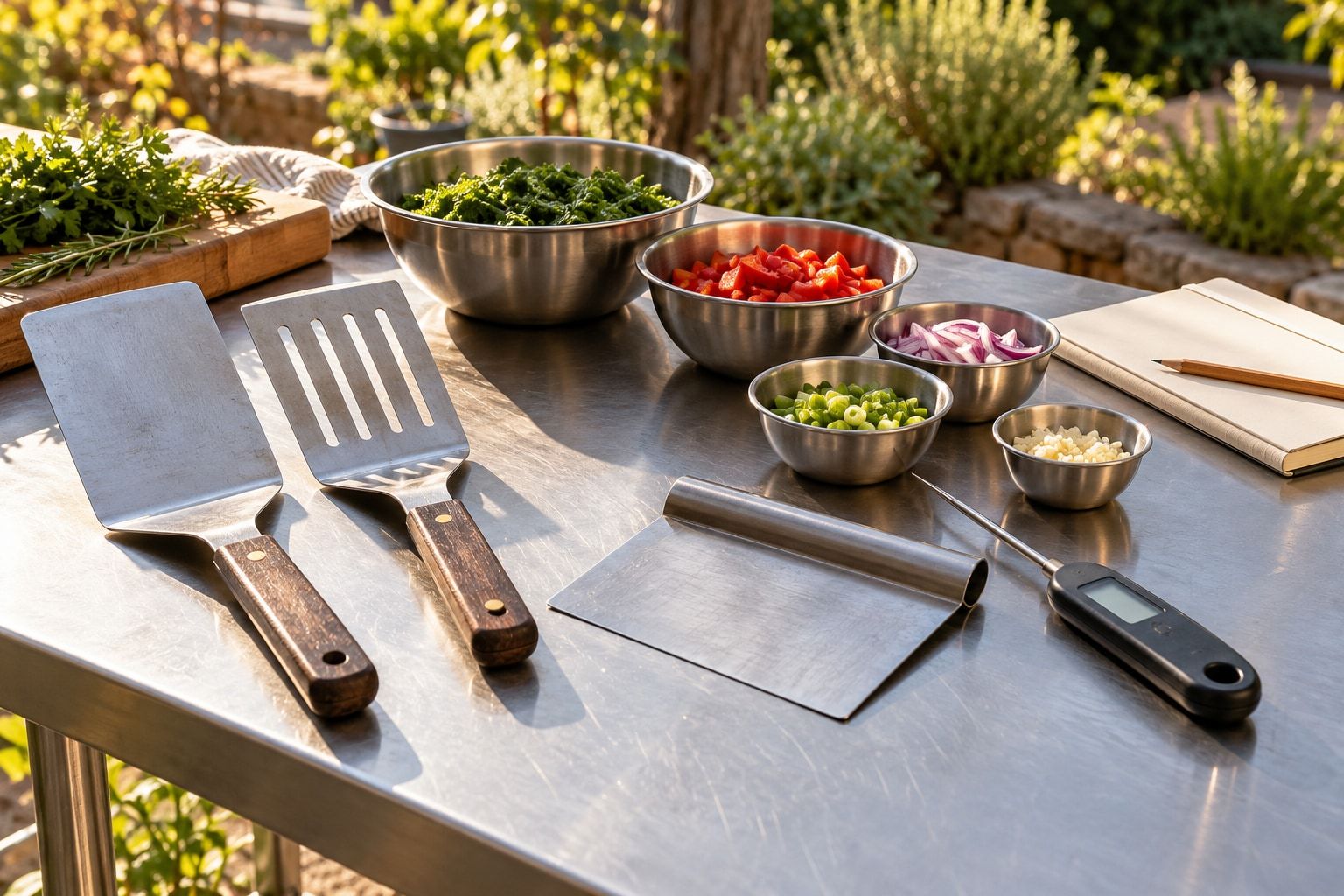
A simpler griddle tool kit
You don't need a 30-piece set to start. Here are the few griddle tools that matter, what each one does and what can wait.