
Tools
A simpler griddle tool kit
You don't need a 30-piece set to start. Here are the few griddle tools that matter, what each one does and what can wait.
In this guide
Research only. Compiled from USDA food safety guidance, manufacturer care instructions, and manufacturer and Amazon listings, read on November 1, 2026. Evidence labels explained.
This article has paid links: Sizzlefolk may earn a commission if you buy through them. As an Amazon Associate I earn from qualifying purchases. How affiliate links work here.
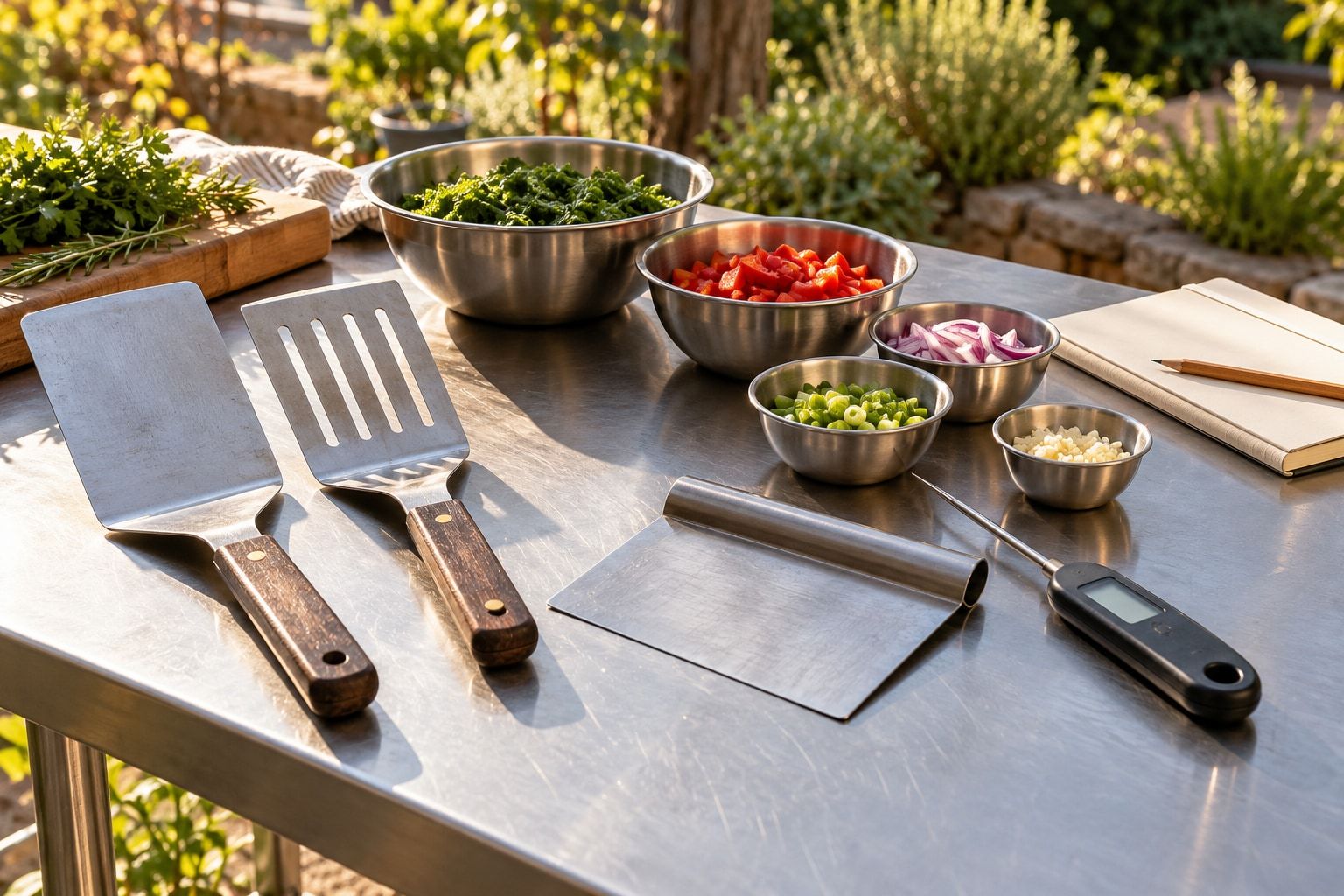
You can cook your first meal with five things: a metal spatula, a scraper, a food thermometer, oil and paper towels. Everything else can wait until you know what you actually like to cook.
Big bundles are tempting. Blackstone’s 30-piece kit was listed at $99 on November 1, 2026, and covers spatulas, tongs, a griddle scraper and cleaning items. That can be fair value if you’d use most of it. It’s just not where you need to start.
Start with these
A metal spatula, or two
This is the tool you’ll use most. Blackstone’s cleaning steps call for a metal spatula or scraper, so you need something that can take contact with hot steel. Two let you turn large or delicate food and move chopped vegetables around. Look for a sturdy blade and a handle long enough to keep your hand away from the heat.
A scraper
A flat scraper clears the surface after cooking and between batches. Pit Boss and Blackstone both say to scrape off food and debris after each cook. A wide bench scraper or griddle scraper covers more of the plate in one pass than a spatula does.
A food thermometer
If you buy only one thing that isn’t for flipping, make it this one. USDA calls a food thermometer the only reliable way to know that food has reached a safe temperature. Color doesn’t tell you: in a USDA study, 21% of participants judged whether their burgers were done by looks like color and grill marks.
An instant-read model suits griddle cooking because food cooks quickly and in thin pieces.
USDA’s minimum internal temperatures:
| Food | Minimum temperature |
|---|---|
| Beef, pork, veal and lamb steaks and chops | 145°F, then rest at least 3 minutes |
| Fish and shellfish | 145°F |
| Ground meats | 160°F |
| Eggs and egg dishes | 160°F |
| All poultry, including ground | 165°F |
Oil and paper towels
These handle seasoning and cleanup. Blackstone suggests options like canola, vegetable or flax oil for seasoning, or its own conditioner. Pit Boss lists vegetable, olive, peanut, coconut and sesame. Paper towels spread a thin layer and wipe up after cooking. Use tongs to hold the towel if the surface is hot.
Add these soon
Heat-resistant gloves. Blackstone lists them for restoring a rusty griddle, and they help any time you’re working close to a hot plate.
Two sets of plates and utensils. USDA says not to use the same platter, board or utensils for raw and cooked food. Bring enough outside, so you aren’t tempted to put cooked burgers back on the raw plate.
A scouring pad. Blackstone’s routine uses one for stuck-on food, with a little water on the warm surface.
A cover. If your griddle doesn’t come with one, it protects the steel between cooks. Blackstone and Pit Boss both recommend covering a griddle when it’s stored.
A fire extinguisher. Pit Boss’s manual says an all-class (ABC) extinguisher is valuable to keep on site. It’s worth having near any outdoor cooker.
What can wait
Each of these can be useful once you know how you cook:
- Burger press or smash tool. A sturdy spatula can do the job at first.
- Melting dome. Handy for cheese and steaming, but not needed on day one.
- Infrared thermometer. Pit Boss sells one as a griddle add-on. It’s aimed at the surface, so it’s useful for checking how hot the plate is. It can’t tell you whether the food is cooked through, so it doesn’t replace a food thermometer.
- Squeeze bottles. Convenient for oil and water, and cheap, so pick them up whenever you notice you’d use them.
- Large bundles. Buy once you know which pieces you’d really use.
A note on cleaning
Manufacturers don’t fully agree here, so follow your own manual. Blackstone says to wash a brand-new griddle with soap once, then skip soap after that and use water on the warm surface. Pit Boss’s cleaning table lists a scrub pad and soapy water for the cooking surface, followed by seasoning with cooking oil. Both agree on the part that matters most: clean it after each cook, and finish with a coat of oil.
Still choosing a griddle? Start with the buying guide. Shopping for someone who already has one? Here are some griddle gift ideas.
This article has paid links: Sizzlefolk may earn a commission if you buy through them. As an Amazon Associate I earn from qualifying purchases. How affiliate links work here.
Sources
- Food Thermometers
- Safe Minimum Internal Temperature Chart
- Grilling Food Safely
- How to take care of your griddle, complete guide
- 30 Piece Accessory Kit
- Owners Manual for Pit Boss 4-Burner Griddle, models PB4BGS1 and PB4BGD1
- ThermoPop 2
- 2B Griddle with Cover & Adapter, PB336GS (lists an infrared thermometer as an add-on)
Related guides
Griddles
Choosing your first griddle
Where it will live, how much surface you need and which features change daily use. A practical way to narrow down a first outdoor griddle.
Griddles
Griddle or grill: where should you start?
A griddle cooks on a flat steel plate and a grill cooks over grates. Here's how that changes your meals, cleanup and first purchase.
Read the comparison: Griddle or grill: where should you start?